


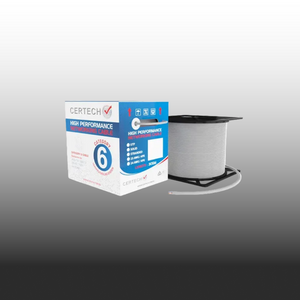








You are on the supplier site at 9pm on a Sunday. The job starts Monday. There are five Cat6A 305m rolls on the screen — U/UTP, F/UTP, S/FTP, LSZH, gel-filled — all 10 Gigabit, all 305 metres, all wildly different prices. You have already made the call to run Cat6A. Now you have to actually order it.
This post is for the cabler at that decision point. Get the variant right and the install certifies clean, the GC signs off, and you go home. Get it wrong and you either lose performance, blow the budget, or worse — pull the wrong cable through a ceiling and replace it on your own dime. Here is the practical decision tree.
Decision One: Shielding Type
This is the single biggest cost lever and the one most cablers default-pick on autopilot. Shielding is not about future-proofing — it is about the electromagnetic environment the cable lives in. Match it to the site, not to the spec sheet.

U/UTP — the workhorse for clean commercial
Unshielded twisted pair. No foil, no braid — just four pairs of conductors with carefully controlled twist rates doing the work. This is the right call for general commercial offices, classrooms, retail tenancies, professional services fit-outs, and any space where the cable tray is well-separated from power runs and there is no significant industrial gear nearby.
U/UTP is lighter, easier to terminate, faster to pull, and cheaper. If the EMI environment is benign, the foil is doing nothing useful — you are paying extra for shielding the site does not need.
F/UTP — the default upgrade for real commercial sites
An overall foil shield wraps all four pairs together. F/UTP is the cable for sites where the data path runs near power conduits, lift shafts, plant rooms, switchboards, fluorescent or LED driver-heavy lighting, or any space with moderate electromagnetic noise. On most multi-storey commercial fit-outs, F/UTP is the right specification — the riser stack alone usually justifies it.
If a project spec says "shielded Cat6A" without specifying which type, F/UTP is almost always what they mean. It is the industry default for commercial.
S/FTP — for severe EMI environments
Overall braided shield plus individual foil-wrapped pairs. This is the heavy artillery — designed for environments where standard shielded cable still cannot keep the noise out. Specify S/FTP for data centres with dense rack-to-rack runs, healthcare imaging suites near MRI or CT, industrial and manufacturing sites with variable speed drives, water treatment plants, and any defence or government install where the spec calls for it explicitly.
S/FTP is harder to terminate, takes longer per drop, and costs more. Do not spec it for an office fit-out — it is overkill that slows the job.
Quick Shielding Reference:
- U/UTP: General commercial, clean office, classroom, retail. From $323 inc GST
- F/UTP: Mainstream commercial, riser routes, near power. From $370 inc GST
- S/FTP: Data centres, hospitals, industrial, government. From $406 inc GST
- Earth bonding: Any shielded cable requires shielded patch panels and end-to-end shield bonding per AS/NZS 3000. Ungrounded shield = useless
Decision Two: Jacket Type
The jacket determines where the cable can legally and safely live. Pick wrong and you fail inspection — or worse, you pass inspection but create a fire-load problem someone else has to discover later. Three jacket types matter on a commercial job.

Standard PVC — general indoor only
Cheaper, fine for general indoor commercial work where there is no fire-egress or smoke-spread requirement. Limited use on most modern commercial sites because Australian fire codes increasingly require LSZH for any cable in plenum spaces, risers, or common-egress zones.
LSZH — the commercial standard
Low Smoke Zero Halogen. When this cable burns it produces minimal toxic smoke and no halogen acid gas. That matters in any space where building occupants need to evacuate — risers, plenum ceilings, fire-rated zones, hospitals, schools, and government buildings.
If the project specification references AS 1530.3 (early fire hazard properties), AS/NZS 3080, or a building code requiring restricted smoke output, LSZH is mandatory. Most modern commercial fit-outs in Australia spec LSZH by default — and every Cat6A indoor roll SparkyZone stocks is LSZH-jacketed for exactly this reason.
Gel-filled — for underground and damp environments
Petroleum jelly fills the cable core. If the outer jacket is nicked or damaged, the gel stops water from migrating along the cable and reaching the conductors. This is the cable for direct-burial runs, sub-floor installations, and any path where moisture is a long-term risk — even in conduit, because conduit fills with condensation.
Gel-filled cable is stiffer, messier to terminate, and not appropriate for indoor risers. Use it where it belongs: underground, sub-floor, or in damp plant rooms. Direct-burial gel-filled also typically does not require conduit (minimum 300mm depth applies).
When LSZH is non-negotiable:
If your cable passes through any of the following, you must spec LSZH — not "nice to have", required:
- Riser shafts: Vertical cable runs between floors
- Plenum ceilings: Return-air voids above suspended ceilings
- Egress paths: Corridors, stairwells, and emergency exit routes
- Healthcare and schools: Any building with vulnerable occupants
- Anywhere AS 1530.3 is called up: Read the cabling spec carefully before you order
Side-by-Side: U/UTP vs F/UTP vs S/FTP
Lay it out across the four things that actually matter on a job:
| Feature | U/UTP | F/UTP | S/FTP |
|---|---|---|---|
| Best environment | Office, retail, classroom — low EMI | Commercial fit-out, risers, near power | Data centre, hospital, industrial |
| EMI protection | Twist rates only | Overall foil shield | Braid + individual pair foil |
| Termination time | Fastest — no shield to manage | Moderate — shield drain to bond | Slowest — braid plus pair foils |
| Cable diameter (OD) | ~7mm | ~7.5mm | ~8mm |
| Roll cost (305m, LSZH) | From $323 inc GST | From $370 inc GST | From $406 inc GST |
| Earth bonding required | No | Yes — both ends | Yes — both ends, every drop |
Decision Three: Colour Coding
Colour is not just for aesthetics. On a commercial job with multiple network types running through the same trays, jacket colour is the fastest documentation system you have. The cabler in twelve months chasing a fault opens the patch panel, sees a yellow cable, and knows it is a security feed before they read a single label.

There is no AS/NZS standard mandating colours, but there is a widely-adopted industry convention across Australian commercial cabling. Use it.
Common Cat6A Colour Conventions:
- Blue: General data drops — workstations, printers, default LAN
- Grey: Voice and telephony (legacy convention, still common)
- White: Wireless access point feeds
- Red: PoE-powered devices, fire/BMS, or VoIP — depends on spec
- Yellow: Security, CCTV, or shielded/segregated networks
- Green: CCTV or out-of-band management
- Purple: AV systems and digital signage
- Orange: Fibre crossconnect copper or carrier demarcation
- Black: Backbone and inter-rack risers
For a multi-network commercial fit-out — say, data plus security plus AV plus PoE lighting — order three or four different colours rather than running everything in blue. The labour cost difference is zero. The fault-finding cost difference, in year three, is hours per incident. Defence and government installs typically mandate specific colour schemes per network classification — always check the project ISM and ACSC guidelines first.
How Many Rolls for the Job
The formula every cabler should know cold:
(Number of drops x average run length x 1.15 wastage) / 305 = rolls required, rounded up
The 15% wastage covers service loops at both ends, mistakes, kinks that have to be cut out, and the fact that real ceiling routes are never as direct as the floor plan suggests. Use 10% only on greenfield slab-on-ground builds where every run is a clean straight pull.

Typical Commercial Fit-Out Sizing:
- 20 drops, small office (~25m avg): 1 roll (with spare = 2)
- 48 drops, medium office (~30m avg): 2-3 rolls
- 100 drops, large fit-out (~35m avg): 5-6 rolls
- 200 drops, multi-floor (~40m avg): 11-12 rolls
- Long single runs (~80-90m): Roughly 3 runs per roll
Conduit Sizing — Don't Skip This
Cat6A cable is fatter than Cat6. The outer diameter is roughly 7-8mm depending on shielding, versus 6mm for typical Cat6. If the conduit was originally sized for Cat6 — or worse, sized for Cat5e on a brownfield job — that 25mm conduit you assumed would carry 24 cables now carries 16, and the cable will not pull cleanly past about 12.

AS/NZS 3000 caps cable fill at 40% of the conduit's internal cross-section. Run the maths before you order, not after the cable arrives:
Conduit Fill — Quick Reference (Cat6A at 7.5mm OD, 40% fill):
- 20mm conduit: ~3 cables maximum
- 25mm conduit: ~6 cables maximum
- 32mm conduit: ~10 cables maximum
- 40mm conduit: ~16 cables maximum
- 50mm conduit: ~26 cables maximum
If the conduit is pre-existing and undersized, you have three options: split the run across two conduits, drop to U/UTP (the smallest OD), or talk to the head contractor before you start pulling. Do not try to overload a conduit — you will damage the cable and fail certification on insertion loss.
Cost Reality on Multi-Roll Orders
Two practical rules on the commercial side of ordering Cat6A in volume:
Rule one: order the spare. If the calculation says five rolls, order six. Returning an unopened roll on a finished job is a five-minute conversation. Stopping a cabling crew because you ran 4 metres short on the last drop costs you a half-day in mobilisation and a phone call to the GC you do not want to make.
Rule two: ask about volume pricing. SparkyZone trade pricing on three or more rolls of the same SKU drops. If you are quoting a 100+ point install or a multi-floor fit-out, email the order through to sales@sparkyzone.com.au with your BOM rather than ordering through the cart — same-day response, sharper pricing on bulk.
Ordering tip — buy the spare roll. The cost of a returned unused 305m roll is zero. The cost of a second courier delivery holding up a cabling crew is half a day of labour plus a frustrated head contractor. Round up, every time. Free shipping kicks in at $300 — every Cat6A roll exceeds this on its own, so multi-roll orders ship free Australia-wide.
Putting It Together
Three decisions, in order, every time:
- ✓ Shielding: Match the EMI environment. Office = U/UTP. Commercial fit-out near power = F/UTP. Industrial, healthcare, data centre = S/FTP
- ✓ Jacket: Indoor riser, plenum, or fire-rated zone = LSZH. Underground or wet = gel-filled. Standard PVC only where the spec allows it
- ✓ Colour and quantity: Order multiple colours for multi-network jobs, calculate at 15% wastage, round up, and always order the spare
Get those three right and the install certifies first time. The infrastructure serves the building for two decades. The GC signs off, the client pays the invoice, and you do not see that ceiling again.
Order Your Cat6A Rolls at SparkyZone
U/UTP, F/UTP, S/FTP, external and gel-filled — all 305m, all 10 Gigabit, all LSZH-jacketed indoor variants. Free shipping Australia-wide on every roll. Same-day dispatch before 2pm AEST. ABN invoiced for trade accounts.
Quoting a multi-roll order? Email sales@sparkyzone.com.au with your BOM for sharper trade pricing.
